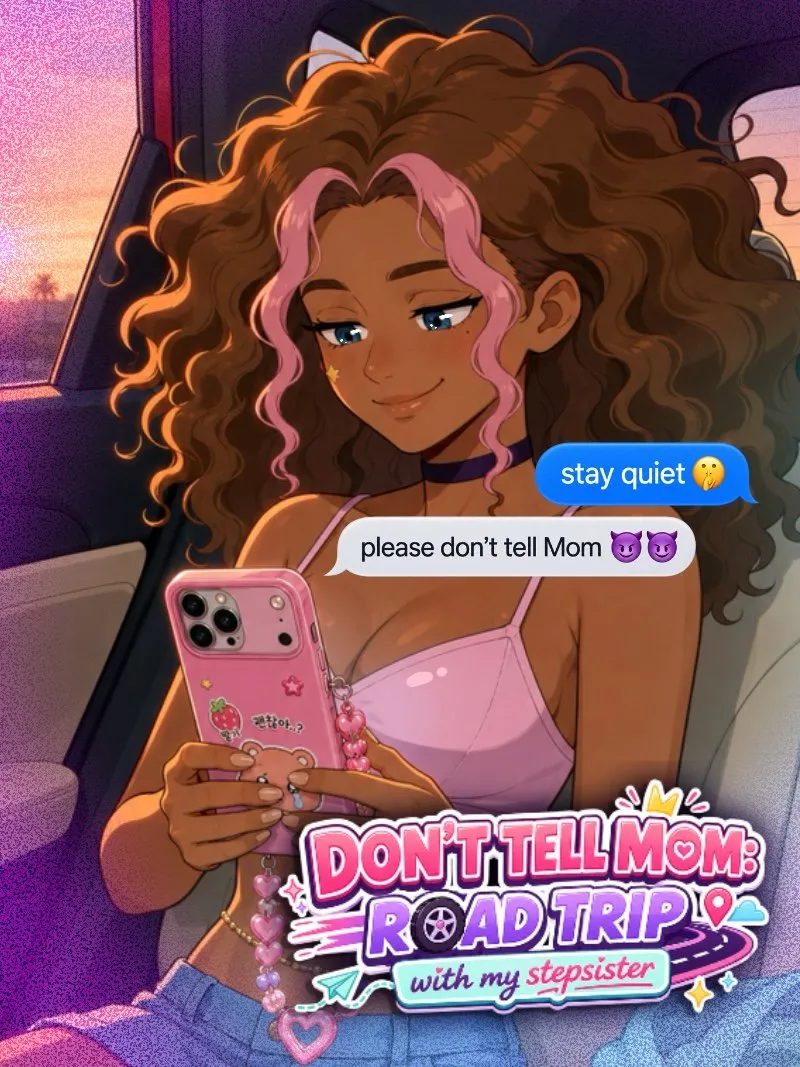
We wanted to make a comic about an OnlyFans-style streamer without treating the phone as a prop. In Don’t Tell Mom, the smartphone is the camera, the audience, the pressure—and sometimes the only character who knows what Remy is really doing.
One month after their parents marry, rule-following Cole and his brand-new stepsister Remy are packed into one car for a 2,000-mile road trip. His dad is driving. Her mom is waiting at the new house they will share. The family thinks Remy is filming harmless social content.
Cole thinks every charged touch is another accident of the road. He does not know she is selling the trip as faceless content on a secret page called OnlyToons—and every new tip asks her to push the performance further.
Why We Built the Story Around a Smartphone
Most comics show a phone when the plot needs a message. We wanted the phone to change the visual grammar of the entire webtoon.
Some panels are framed like vertical video. Others borrow the language of live streams: viewer counts, comments, tips and requests appearing beside the action. Reflections in the screen reveal what Remy is hiding. Cropped compositions show only what her subscribers are allowed to see—while the wider comic panel shows how close the family is to discovering it.
If Remy is performing, the reader should always be aware of the lens—even when Cole is not.
This gave the comic a fresher rhythm than a conventional adult pornhwa. The reader moves between three perspectives: the “safe” family road trip, Cole's confused point of view and the deliberately provocative version Remy is packaging for OnlyToons.
OnlyToons Turns Attention Into a Plot Mechanic
OnlyToons is our fictional subscription platform, inspired by the creator economy around sites such as OnlyFans but not affiliated with them. We were less interested in copying a familiar interface than in dramatizing what happens when an invisible audience can influence a real journey.
Every tip creates a small narrative contract. Remy can refuse, but refusal means disappointing the audience she has trained to expect escalation. Accepting means using Cole in a performance he does not yet understand. The money raises the stakes, but attention is the stronger drug.
The Public-Kink Tension Is Built Into the Car
A road trip is private and public at the same time. The characters are trapped in a small shared space, yet every stop places them among strangers, cameras, motel hallways and family members who could turn around at the wrong moment.
That constant caught risk is what gives the story its public-kink energy. The thrill is not an empty promise that “someone might see.” Someone is always one seat away. Cole's father is driving. Remy's mother is waiting at the destination. A phone can light up with the wrong notification. A subscriber can request something that is impossible to hide.
The closer they get to home, the less time Remy has to keep OnlyToons separate from the new family life awaiting them.
Cole Is the Only Person Who Does Not Know the Premise
Cole begins as a rule-follower. He explains away Remy's flirting because the alternative would force him to admit that their new stepsibling relationship already feels unstable. She leans too close; the road is bumpy. Her hand stays too long; the car is cramped. The phone points toward them; she is making ordinary social content.
That dramatic irony lets the audience read two stories at once. To Cole, the tension is accidental. To Remy's subscribers, it is the product. To Remy, it gradually becomes something harder to categorize.
When Cole eventually understands why she has been flirting, the discovery cannot remain a simple reveal. He has to confront the fact that private moments were performances—and Remy has to confront the possibility that the feelings inside those performances were real.
Where the Content Ends
The central question is not whether Remy is “faking it.” Performance can create genuine feeling. Repeating a flirtation for the camera can make it easier to attempt without one. Playing a taboo role can reveal that the role fits more comfortably than expected.
That is why the OnlyFans-inspired premise matters beyond its keywords. OnlyToons gives Remy an excuse to cross boundaries while postponing responsibility: it was for the page, for the tip, for the shot. Cole's discovery removes that excuse. Their relationship can only move forward once both of them know what has been happening.
A Pornhwa With Western Road-Movie Energy
Don’t Tell Mom sits between formats. It uses the vertical pacing and escalating hooks readers expect from a webtoon or pornhwa, while its 2,000-mile journey borrows from the western road comic: changing landscapes, motel stops, roadside attractions and a destination that puts a clock on every choice.
The road prevents the story from resetting. Every episode moves the family closer to the house where Cole and Remy will live as stepsiblings. Every secret captured on the phone travels with them. There is no clean way to turn around.
Read Don’t Tell Mom
Remy calls it content. Cole calls it an accident. They have 2,000 miles to discover which one of them is lying.
Read the Prologue →Don’t Tell Mom FAQ
What is Don’t Tell Mom about?
Cole and his new stepsister Remy begin a 2,000-mile family road trip. Cole does not know that Remy is selling faceless content from the journey through a secret OnlyToons page, where every tip pushes the performance further.
Is Don’t Tell Mom an OnlyFans webtoon?
The story is inspired by the creator-economy tension associated with subscription platforms such as OnlyFans, but uses a fictional service called OnlyToons. It has no official connection to OnlyFans.
Is Don’t Tell Mom a taboo pornhwa?
Yes. It is an adult taboo pornhwa about two adult new stepsiblings, a secret content page and the constant possibility of being caught during a family road trip.
Why does the comic show so much through a phone?
Smartphone framing is the comic's visual signature. Camera views, comments, tips and cropped video compositions let readers see the public performance and the private road trip simultaneously.
Where can I read Don’t Tell Mom?
You can read the Don’t Tell Mom prologue on yumeku.