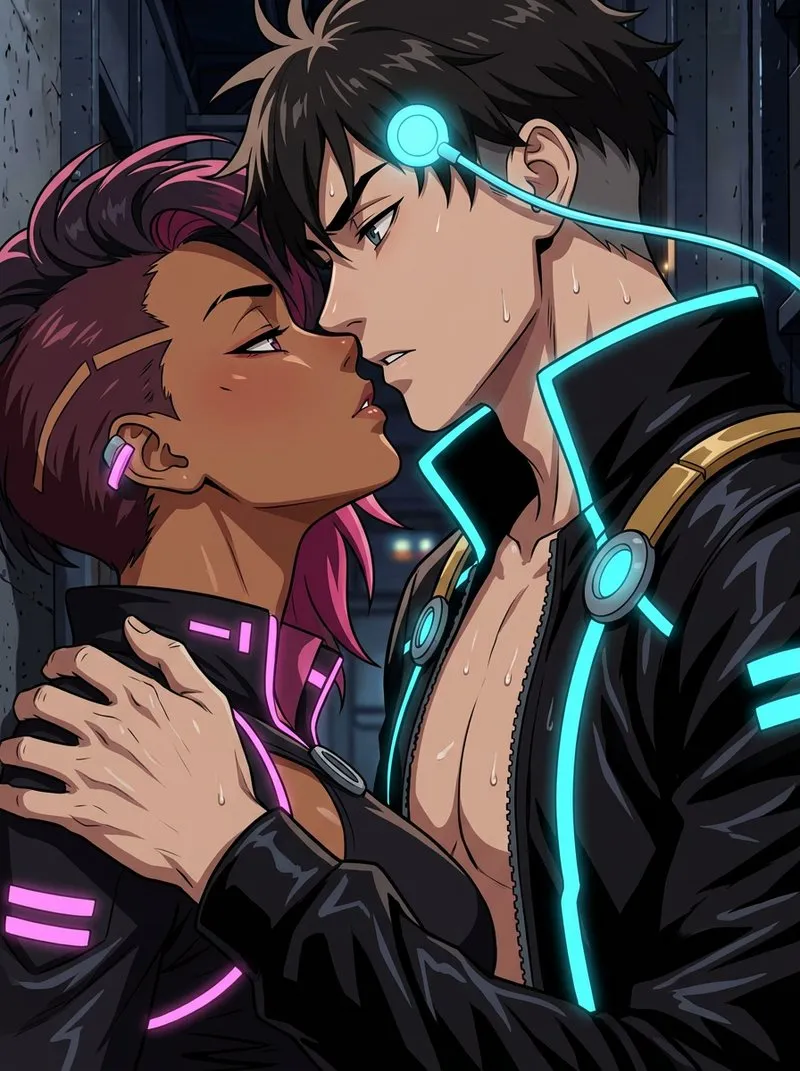
Cyberpunk has always asked what happens when technology gets under our skin. With Two-Body Problem, we wanted to ask a more intimate question: what if another person could feel everything happening under it?
Jun and Mei buy TANDEM, a black-market neural rig designed to synchronize two nervous systems. They are not chasing novelty. They are trying to revive a marriage that has gone numb. The promise is seductive: no more guessing, no more distance, no more pretending. If one body feels it, the other body knows.
Then they leave the connection live.
We Wanted Cyberpunk to Feel Physical
Most cyberpunk stories make technology visible through chrome limbs, neon streets and corporate weapons. We wanted the technology in Two-Body Problem to be almost invisible. TANDEM does not make Jun and Mei stronger. It makes them unable to hide.
The device turns sensation into data and intimacy into a network protocol. A touch received by Mei is transmitted to Jun. A rush of desire in Jun returns through Mei's implant. The signal does not care whether the sensation is welcome, inconvenient or impossible to explain.
What begins as perfect empathy becomes involuntary honesty. The body reports what the mouth refuses to admit.
Why Two Bodies Were Not Enough
A simple couple-link gave us an intriguing adult sci-fi comic. Adding two more people turned it into a problem.
Vess is the coworker Jun has wanted for a year. Iris is the client Mei cannot stop watching. Neither woman is supposed to be inside TANDEM. Yet the morning after Jun and Mei activate the rig, unfamiliar sensations begin arriving through the signal—and the network recognizes four bodies instead of two.
Now every forbidden touch comes back doubled. Desire travels in both directions. Jealousy is no longer an idea; it arrives as a physical sensation. Nobody can be certain where an impulse began, only that everybody connected to the loop may feel where it ends.
A Sex Comic Built Like a Feedback System
The central rule of the story is escalation through feedback. Every attempt to resist generates a stronger signal. Suppressed attraction becomes measurable. A private encounter becomes a shared event. One person's reaction stimulates another, whose response returns through the network with more intensity.
That structure let us build adult scenes as plot rather than interruption. Pleasure reveals alliances. Arousal exposes betrayal. The person who appears passive may be amplifying the entire loop. The person trying hardest to disconnect may secretly be the one keeping it alive.
It is the logic of a machine applied to four unreliable human beings: input, transmission, amplification, repeat.
From Cyberpunk 2077 Energy to an Intimate Pornhwa
Readers who enjoy the braindance, neural-interface and body-modification ideas associated with Cyberpunk 2077 will recognize the genre territory: illicit hardware, sensations converted into signals and technology that reaches the mind before the user understands the cost.
But Two-Body Problem is an independent yumeku Original, not connected to Cyberpunk 2077. Our focus is smaller and more intimate. There is no city to save. The crisis is four people trying to work out whether their desire belongs to them anymore.
That is why the pornhwa format fits the premise. Sequential art can move between bodies in a fraction of a page: Mei's expression, Jun's involuntary reaction, Vess noticing something impossible, Iris realizing she is being felt. The reader experiences the same confusion as the characters—the signal crosses the gutter before anyone can contain it.
The Real Fantasy Is Radical Sensory Empathy
Beneath the sex and neon, TANDEM offers something many relationships quietly want: proof. Proof that your partner feels what they say they feel. Proof that desire is still alive. Proof that pleasure is shared rather than performed.
Jun and Mei buy that fantasy because conversation has failed them. The machine succeeds too well. It gives them perfect sensory empathy without privacy, context or control. They can feel the truth, but they cannot know what it means.
Vess and Iris make the problem more dangerous because attraction stops being a private betrayal. It becomes network traffic. Every body is both participant and witness.
Why We Called It Two-Body Problem
The title begins as a promise: two bodies, synchronized. It becomes a warning the moment the system expands. TANDEM can model a pair. It cannot predict a four-person loop filled with desire, jealousy and competing intentions.
In physics, adding another body turns a solvable orbit into chaos. In our comic, adding two more turns intimacy into something equally unstable. Nobody controls the system because everybody changes it simply by feeling.
Read Two-Body Problem
Jun and Mei wanted to feel close again. TANDEM gives them Vess, Iris and a connection that refuses to stay private.
Read the Prologue →Two-Body Problem FAQ
What is Two-Body Problem about?
Jun and Mei use TANDEM, a black-market neural rig that lets them feel every sensation in each other's bodies. The signal unexpectedly expands to include Vess and Iris, creating a four-body feedback loop.
Is Two-Body Problem a cyberpunk adult comic?
Yes. It is an adult sci-fi comic and cyberpunk pornhwa built around neural implants, illicit technology, shared sensation and the loss of bodily privacy.
Is Two-Body Problem connected to Cyberpunk 2077?
No. Two-Body Problem is an independent yumeku Original. It explores familiar cyberpunk themes such as body modification and digitized sensation, but has no official connection to Cyberpunk 2077.
Why is it called Two-Body Problem if four people are connected?
The title describes TANDEM's intended design: a stable link between two bodies. The story begins when that controlled pair becomes an unpredictable four-person system.
Where can I read Two-Body Problem?
You can read the Two-Body Problem prologue on yumeku.